
Las Vegas Electric Bill: NV Energy vs. Solar Panels for Single-Family Homes
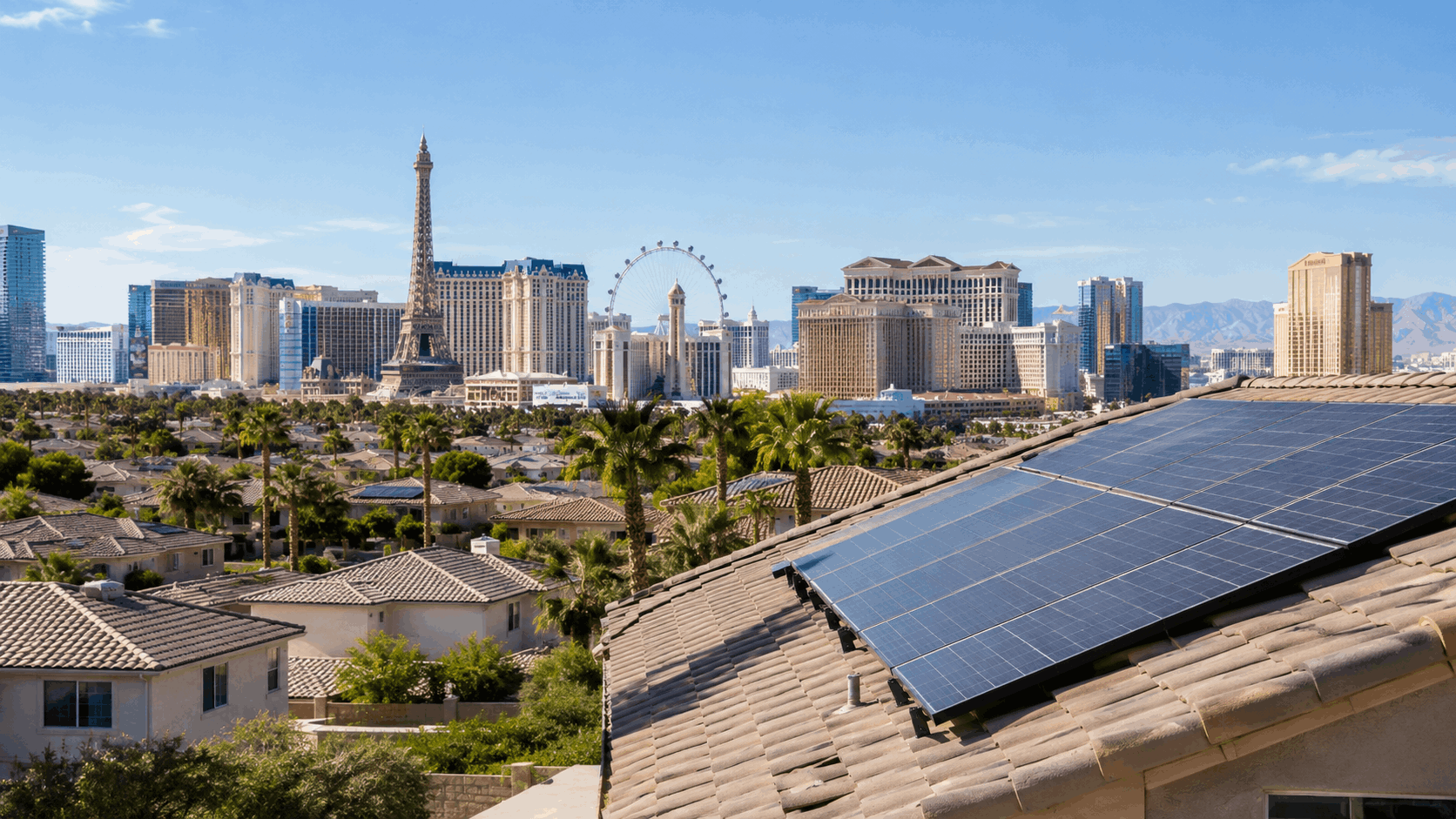 Quick Answer
Electricity is an important part of the monthly budget for Las Vegas homeowners, especially during the summer when air conditioning use increases substantially.
NV Energy is the primary electric utility serving most of the Las Vegas Valley. As of July through September 2026, NV Energy lists a standard Southern Nevada residential energy rate of approximately 11.622 cents per kilowatt-hour before other applicable charges, fees, and adjustments.
Your actual electric bill can vary significantly depending on the size and age of the home, insulation, thermostat settings, air-conditioning efficiency, pool equipment, electric vehicles, appliances, and how much electricity your household uses.
Solar can reduce the amount of electricity you purchase from NV Energy, but it should not automatically be viewed as a guaranteed money-saving investment.
System cost, financing, roof condition, household energy usage, how long you expect to own the home, and Nevada's current net-metering rules all affect whether solar makes financial sense.
One major change buyers should know about is that the federal Residential Clean Energy Credit for homeowner-installed residential solar ended for expenditures after December 31, 2025. Buyers evaluating solar in 2026 should not assume they will receive the former 30% homeowner federal tax credit.
Who This Guide Is For
This guide may be useful if you are:
- Moving to Las Vegas from California or another state: You want to understand how summer electricity use may affect your monthly housing budget.
- Buying your first home: You are comparing the mortgage payment with the other ongoing costs of ownership.
- Considering a home with existing solar: You want to know whether the system is owned, financed, leased, or subject to a Power Purchase Agreement.
- Thinking about adding solar: You want to compare installation costs with expected electricity savings.
- Buying a larger or luxury home: You may have higher electricity consumption from multiple AC units, pools, spas, EV charging, or larger living areas.
- Buying an investment property: You want to understand how an existing solar agreement could affect the property and a future sale.
Why Electric Bills Matter in Las Vegas
Las Vegas has long, hot summers, and air conditioning can account for a large share of household electricity consumption during the hottest months.
That means two homes with similar purchase prices can have very different utility costs.
A newer home with efficient HVAC equipment, modern insulation, energy-efficient windows, and a well-sealed building envelope may use considerably less electricity than an older property of similar size.
Other factors that can increase electricity use include:
- Swimming pools and pool pumps
- Multiple air-conditioning systems
- Older HVAC equipment
- Poor insulation
- Large west-facing windows
- Electric vehicle charging
- Electric water heating
- Large refrigerators or freezers
- Home offices and computer equipment
- Thermostat settings
- Number of occupants
This is why I would not estimate a home's future electric bill based only on its square footage.
Understanding NV Energy Residential Rates
NV Energy serves most residential electric customers in Southern Nevada.
As of July 1 through September 30, 2026, NV Energy lists the standard Southern Nevada residential energy rate at approximately 11.622 cents per kilowatt-hour before other applicable charges and fees.
Electric rates can change periodically, so homeowners and buyers should always verify the current rate directly with NV Energy.
Standard Residential Service
One correction that is important when comparing electricity costs: NV Energy's standard Southern Nevada residential plan is not currently structured as a traditional usage-tier system where each additional block of electricity automatically costs more per kilowatt-hour.
The standard residential schedule generally charges the applicable residential energy rate for usage along with a monthly basic service charge and other applicable adjustments and fees.
Time-of-Use Plans
NV Energy also offers optional Time-of-Use pricing.
With a Time-of-Use plan, electricity rates vary depending on when electricity is consumed.
Electricity used during designated peak-demand periods costs more, while electricity used during off-peak periods costs less.
This may work well for households that can shift significant electricity use away from peak hours.
For example, homeowners may be able to move activities such as EV charging, laundry, dishwashing, or some cooling to off-peak periods.
The specific peak hours and pricing can change, so homeowners should review the current NV Energy Time-of-Use schedule before enrolling.
How Much Is a Typical Las Vegas Electric Bill?
There is no reliable single electric-bill number that applies to every Las Vegas home.
A 2,000-square-foot home with newer HVAC equipment and efficient insulation could use substantially less electricity than another 2,000-square-foot home with an older AC system, pool, poor insulation, and lower thermostat settings.
Summer bills are generally higher because air-conditioning demand increases significantly during extended periods of triple-digit temperatures.
When I am helping a buyer evaluate a specific property, one of the most useful things they can do is ask the seller, when available and appropriate, for recent utility-cost information.
Even then, past bills should be treated only as a reference because your household's usage may be very different.
How Much Does Solar Cost in Las Vegas in 2026?
Solar pricing depends primarily on system size, equipment, roof configuration, installer pricing, electrical upgrades, battery storage, and financing.
According to EnergySage's September 2026 Las Vegas marketplace data, residential solar installations average approximately $2.42 per watt.
The average system quoted in its Las Vegas data was approximately 13.49 kilowatts, with an average installed price of roughly $32,636 before any available incentives.
That does not mean every homeowner needs a $30,000-plus system.
A smaller home or a household with lower electricity consumption may need a substantially smaller system, while a larger home with multiple HVAC units, a pool, or EV charging may require more capacity.
The most useful comparison is usually the cost per watt, total financed or cash price, estimated annual production, equipment warranties, and projected electricity offset.
Important 2026 Change: The Federal Residential Solar Tax Credit
This is one of the biggest changes homeowners need to know about.
The former federal Residential Clean Energy Credit allowed qualifying homeowners to claim a 30% federal tax credit for qualifying solar installations.
That homeowner credit is no longer available for residential clean-energy expenditures after December 31, 2025.
So if you are pricing a homeowner-owned solar system in 2026, do not automatically subtract 30% from the installation cost.
Some solar advertisements or online calculators may still show the former credit, so make sure any proposal you receive reflects current 2026 rules.
Tax situations can vary, so buyers and homeowners should confirm any available incentives with a qualified tax professional and current government guidance.
How Nevada Net Metering Works
Nevada still has net metering for qualifying residential solar systems.
When your solar panels produce electricity, your home uses that energy first.
If the system produces more electricity than your home is using, the excess can be exported to the NV Energy grid.
NV Energy then provides a credit under the applicable net-metering rate.
Current Tier 4 Net-Metering Credit
NV Energy's current NMR-405 Tier 4 is open for new qualifying rooftop solar applications.
Under Tier 4, excess electricity remaining after monthly netting is credited at 75% of the applicable retail volumetric electricity rate, excluding certain public-policy charges.
The credit rate associated with the tier applies for 20 years under NV Energy's current program.
This is important because exported solar electricity is not necessarily worth the same amount as electricity you purchase from the utility.
It can therefore be financially beneficial to use more of your solar production inside the home instead of designing a system primarily to produce large amounts of excess electricity for the grid.
Net Metering Does Not Usually Eliminate Every Utility Charge
Solar homeowners generally remain connected to the NV Energy grid and may still pay the monthly basic service charge and other applicable fees or charges.
Solar should therefore be described as potentially reducing the electric bill rather than automatically eliminating it.
How Long Does Solar Take to Pay for Itself?
There is no single reliable payback period that applies to every Las Vegas homeowner.
Older estimates often suggested approximately five to ten years, but those calculations frequently assumed the former 30% federal residential tax credit.
Because that homeowner credit is no longer available for new 2026 residential installations, current payback periods may be longer.
Your actual payback depends on:
- Total solar system cost
- Cash versus financing
- Loan interest rate
- Dealer fees or financing fees
- System size
- Annual electricity consumption
- Solar production
- NV Energy electricity rates
- Net-metering credits
- Roof orientation and shading
- System degradation
- Maintenance
- How long you own the property
A solar salesperson's projected savings should be treated as an estimate, not a guarantee.
Owned Solar vs. Solar Loans vs. Leases and PPAs
One of the most important questions when buying a Las Vegas home with solar is not simply whether the home has panels.
You need to know how the system is owned and financed.
Owned Solar
An owned system that has been paid off is generally the simplest arrangement for a future real estate transaction.
The buyer usually receives the solar equipment with the home without taking over a separate solar payment.
Solar Loan
If the seller financed the system, determine the remaining balance and how the loan will be handled when the property is sold.
Do not assume a solar loan automatically transfers with the home.
Solar Lease
With a lease, a third party typically owns the system and the homeowner makes scheduled payments for use of the equipment.
The lease terms should be reviewed carefully before purchasing the property.
Power Purchase Agreement
Under a Power Purchase Agreement, or PPA, a third party owns the system and the homeowner agrees to purchase the electricity the system generates under the contract.
Some agreements include annual price escalators.
When buying a home with leased solar or a PPA, buyers should review:
- Current monthly payment
- Remaining contract term
- Annual escalator, if any
- Transfer requirements
- Buyout options
- Credit qualification requirements
- End-of-contract terms
A lease or PPA is not automatically a bad deal, but the contract needs to be evaluated separately from the home itself.
Does Solar Increase Home Value?
Owned solar may contribute value to a property, but homeowners should be careful with blanket claims that solar automatically increases the home's value by a certain amount.
Research from Lawrence Berkeley National Laboratory has found sale-price premiums for some homes with homeowner-owned solar systems.
However, those studies do not mean every Las Vegas home with solar will sell for more.
The contributory value can depend on:
- Whether the system is owned
- Age of the panels
- Remaining useful life
- System size
- Electricity production
- Electricity rates
- Buyer preferences
- Comparable home sales
- Financing terms
- Appraisal support
Third-party-owned systems, including some leases and PPAs, should not automatically be treated as adding the same value as an owned system.
Las Vegas Sunshine and Solar Production
Southern Nevada receives abundant sunshine, which gives Las Vegas strong solar-generation potential.
However, more sunshine does not mean every roof is ideal for solar.
Production depends on several factors, including:
- Roof orientation
- Roof pitch
- Shading
- Panel efficiency
- System design
- Dust and debris
- Equipment condition
- Season
High temperatures can also affect solar-panel efficiency, so maximum summer sunlight does not necessarily mean maximum efficiency at every moment of the day.
Should You Clean Solar Panels in Las Vegas?
Dust can accumulate on solar panels in Southern Nevada.
Whether professional cleaning makes financial sense depends on how much buildup is present and whether it is materially reducing production.
Before paying for frequent cleaning, homeowners can monitor their solar-production data to see whether performance has meaningfully declined.
Always follow the panel manufacturer's maintenance recommendations.
Solar and HOA Rules in Nevada
Many Las Vegas Valley communities have homeowners associations, including communities in Henderson, Summerlin, Inspirada, Providence, Skye Canyon, and other master-planned areas.
Nevada law limits the ability of an HOA to prohibit a qualifying distributed-generation system such as rooftop solar.
However, associations may adopt certain reasonable installation requirements.
For example, Nevada law allows some placement requirements as long as they do not decrease system production beyond the limits established by law or significantly increase installation costs.
Homeowners should still submit any required architectural application and review the current HOA rules before installing a system.
What About Solar Batteries?
Battery storage can allow a homeowner to store electricity generated by solar panels and use it later.
Possible uses include:
- Backup power during an outage
- Using stored solar electricity at night
- Reducing grid electricity consumption during higher-cost periods
- Increasing the amount of solar energy used directly by the household
Battery systems add substantial cost, so the financial case should be evaluated separately from the solar panels.
EnergySage's September 2026 Las Vegas marketplace data showed an average cost of approximately $10,593 for a 13-kWh battery installation before available incentives.
Battery pricing varies significantly by manufacturer, capacity, installation requirements, and whether it is installed with a new solar system or added later.
Energy Efficiency May Be the Best Place to Start
Before installing solar, it may make sense to determine whether the home is wasting electricity.
Possible improvements include:
- HVAC maintenance or replacement
- Improved attic insulation
- Air sealing
- Smart thermostat settings
- Efficient pool pumps
- Window coverings
- Duct sealing
- LED lighting
- Efficient appliances
Reducing electricity consumption before sizing a solar system may allow the homeowner to purchase a smaller system.
Common Solar Mistakes Las Vegas Homeowners Make
- Assuming the federal 30% homeowner solar credit still exists: For residential clean-energy expenditures after December 31, 2025, that homeowner credit is no longer available.
- Looking only at the monthly solar payment: A low monthly payment can sometimes result from a long loan term, higher interest cost, or financing fees.
- Ignoring the cash price: Always ask for both the cash price and financed price.
- Assuming solar will eliminate the NV Energy bill: Grid-connected homeowners may still have utility charges even when solar offsets most electricity consumption.
- Oversizing the system: Nevada's net-metering program does not necessarily credit excess exports at the full retail electricity rate.
- Signing a lease or PPA without reading the transfer terms: The agreement may affect a future sale.
- Installing panels on a roof that may need replacement soon: Removing and reinstalling solar panels later can add expense.
- Trusting projected savings without reviewing the assumptions: Electricity-rate increases, production estimates, system degradation, financing costs, and household usage are all assumptions that can affect the result.
- Getting only one quote: System designs, equipment, financing terms, warranties, and prices can vary significantly between installers.
Frequently Asked Questions
What is NV Energy's current residential electricity rate in Las Vegas?
For July through September 2026, NV Energy lists a Southern Nevada standard residential energy rate of approximately 11.622 cents per kilowatt-hour before other applicable fees, charges, and adjustments.
Rates can change periodically, so verify the current rate directly with NV Energy.
How much will my Las Vegas electric bill be?
There is no dependable average that accurately predicts what a specific household will pay.
Home size, HVAC efficiency, insulation, thermostat settings, pools, EV charging, number of occupants, and other factors can substantially change electricity consumption.
Does Nevada still have net metering?
Yes.
NV Energy currently accepts qualifying new rooftop solar customers into Tier 4 of its NMR-405 net-metering program.
Tier 4 currently provides a credit equal to 75% of the applicable retail volumetric electricity rate, excluding certain public-policy charges, for eligible excess energy after monthly netting.
Does solar eliminate my NV Energy bill?
Not necessarily.
Solar may substantially reduce electricity purchased from the grid, but customers may still pay basic service charges and other applicable fees or charges.
Is there still a 30% federal solar tax credit in 2026?
Not for new homeowner residential clean-energy expenditures after December 31, 2025.
The former Residential Clean Energy Credit ended for expenditures after that date.
Because tax rules can change and individual situations vary, homeowners should verify current incentives with the IRS and a qualified tax professional.
How much does solar cost in Las Vegas?
EnergySage's September 2026 marketplace data shows average Las Vegas solar pricing of approximately $2.42 per watt.
Actual pricing depends on system size, equipment, roof configuration, electrical work, battery storage, installer pricing, and financing.
How long does solar take to pay for itself?
It depends on the individual property and system.
The system price, financing, household electricity consumption, utility rates, solar production, net-metering credits, and ownership period all affect the calculation.
Older five-to-ten-year estimates may no longer apply because many assumed the former 30% federal homeowner tax credit.
Can my HOA prohibit solar panels?
Nevada law generally limits an HOA's ability to prohibit qualifying rooftop solar systems, although associations may impose certain reasonable requirements regarding installation.
Always review the specific HOA's current architectural rules before installing solar.
Should I buy a house with leased solar?
Possibly, but review the solar contract before deciding.
Look at the payment, remaining term, escalator, transfer requirements, buyout options, and how the agreement compares with the home's expected electricity usage.
Is paid-off solar better when buying a home?
Paid-off homeowner-owned solar is generally simpler to evaluate because there is no separate solar payment or third-party agreement to assume.
However, buyers should still evaluate the system's age, condition, production, warranties, roof condition, and expected remaining useful life.
Bottom Line: NV Energy or Solar?
There is no universal answer.
For some Las Vegas homeowners, a properly priced solar system may reduce long-term electricity costs.
For others, especially someone planning to move in a few years or someone considering an expensive financed system, the numbers may not make sense.
The biggest mistake is treating solar as automatically good or automatically bad.
If you are buying a home that already has solar, I recommend finding out:
- Who owns the system?
- Is it paid off?
- Is there a solar loan?
- Is it leased?
- Is there a PPA?
- What is the current payment?
- Does the payment increase?
- How many years remain?
- What does the system actually produce?
- What were the property's recent NV Energy bills?
- How old is the roof?
- How old is the solar system?
Those answers tell you much more than simply seeing solar panels on the roof.
If you're considering a home in Las Vegas, Henderson, or North Las Vegas and it has solar, send me the property address and the solar information if it's available. I can help you understand what questions to ask and what to look for before moving forward.
Kyle Fujimoto, Nevada Real Estate License No. S.0184988, Platinum Real Estate Professionals
Kyle Fujimoto, California DRE License No. 02230384, affiliated with Dynasty Real Estate
Equal Housing Opportunity.
Information is deemed reliable but not guaranteed and should be independently verified.
Utility rates, solar programs, net-metering rules, incentives, equipment prices, and tax laws can change without notice.
This content is for general informational purposes only and is not legal, tax, financial, insurance, appraisal, inspection, solar-installation, engineering, or lending advice.
Solar production, electricity savings, system performance, payback periods, home-value effects, and future utility costs are not guaranteed.
Buyers and homeowners should independently verify solar contracts, system ownership, liens, loans, leases, PPAs, warranties, utility bills, equipment condition, roof condition, HOA requirements, tax incentives, and net-metering eligibility.
Consult qualified solar, roofing, electrical, tax, legal, and other professionals when appropriate.
Not intended to solicit a buyer or seller currently under an exclusive agreement with another real estate brokerage.
Categories
Recent Posts


GET MORE INFORMATION

REALTOR® Lic# S.0184988