
Las Vegas Garage Conversion ADU Permits and Regulations You Need to Know
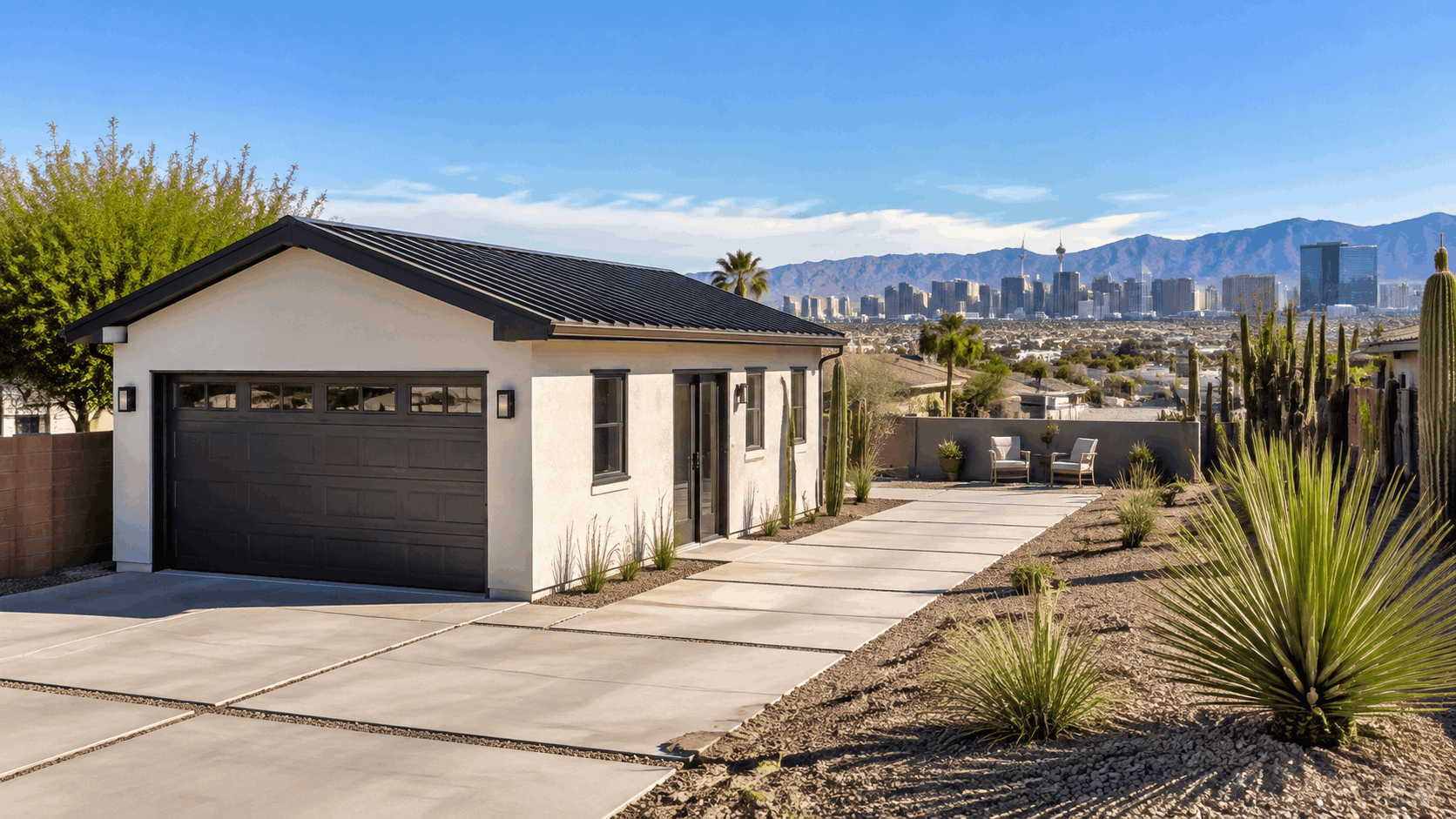
Thinking about converting your garage into an Accessory Dwelling Unit, or ADU, in the Las Vegas Valley? It can be a smart way to create additional living space, house family members, or potentially generate rental income. But the rules are more complicated than simply adding walls, plumbing, and a kitchen.
Garage conversions require permits, building-code compliance, zoning review, and careful attention to parking, utilities, HOA restrictions, and how the property will ultimately be used.
There is also an important recent change homeowners need to know about: Nevada's ADU laws changed effective July 1, 2026. The new state law places limits on certain restrictions that local governments can impose on accessory dwelling units.
Quick Answer
Converting a garage into an ADU in the Las Vegas Valley will generally require building permits and compliance with the rules of the jurisdiction where the property is located. That could be the City of Las Vegas, Henderson, North Las Vegas, or unincorporated Clark County.
Typical review may involve zoning, structural work, electrical, plumbing, mechanical systems, energy requirements, fire safety, and parking.
However, Nevada law now requires qualifying cities and counties to allow ADUs on eligible single-family residential properties while limiting some of the restrictions local governments can impose.
Because the rules can differ by jurisdiction and can change over time, the best approach is to verify the requirements for the exact property before spending money on architectural plans or construction.
Major Nevada ADU Law Change Effective July 1, 2026
Nevada adopted new statewide ADU requirements that became effective July 1, 2026. These rules apply to larger Nevada cities and counties, including jurisdictions within the Las Vegas Valley.
The law requires qualifying local governments to authorize accessory dwelling units on eligible single-family residential properties, subject to reasonable development, health, safety, and building standards.
Among other things, local governments generally cannot:
- Prohibit an ADU from having a full kitchen.
- Require side or rear setbacks that are more restrictive than those that apply to the primary residence.
- Require more than one additional parking space for the ADU when existing on-site and street parking can reasonably accommodate parking needs.
- Prohibit an ADU from being rented as ordinary residential housing.
Local governments may still regulate issues such as building safety, maximum size, height, utilities, design, lot configuration, fire protection, and short-term rental use.
This means older information you may find online about Las Vegas-area ADUs may no longer tell the full story.
Who This Guide Is For
This guide is especially useful if you are:
- A homeowner: You are considering turning your garage into additional living space or a rental unit.
- An investor: You are evaluating whether an ADU conversion could improve cash flow or resale value.
- A family needing additional space: You want private living quarters for parents, adult children, or other relatives.
- An out-of-state buyer: You are purchasing in Las Vegas and want to understand ADU potential before buying.
- A California buyer relocating to Nevada: You may be familiar with California ADU rules, but Nevada and local requirements are different.
What Is an ADU?
An Accessory Dwelling Unit is a secondary residential unit located on the same property as a primary home.
An ADU can potentially be:
- A converted garage.
- A unit attached to the primary residence.
- A detached backyard unit.
- A unit built above a garage.
A true ADU generally includes independent living facilities, including sleeping space, a bathroom, and kitchen facilities.
Under Nevada law, kitchen facilities may include a sink, refrigerator, and a significant cooking appliance such as a range, stove, or oven.
Why Las Vegas Homeowners Consider Garage Conversion ADUs
Additional Living Space
An ADU can provide separate living quarters for aging parents, adult children, extended family members, or guests.
Rental Income
A legal ADU may potentially be rented as long-term housing, subject to applicable laws, lease requirements, HOA restrictions, and local regulations.
Do not assume that approval as an ADU automatically means the unit can be operated as a short-term rental.
Property Value
A properly permitted ADU may improve a property's usefulness and appeal to future buyers. Whether it actually increases value, and by how much, will depend on the property, neighborhood, design, market conditions, and comparable sales.
Flexible Use
The space might also be used for family, guests, a private office, or other purposes permitted by local rules.
General Requirements for a Las Vegas Garage Conversion
1. Building Permits
A garage conversion into habitable space normally requires permits.
Depending on the project, permits and inspections may involve:
- Structural modifications.
- Electrical work.
- Plumbing.
- HVAC.
- Insulation.
- Windows and emergency egress.
- Fire separation.
- Energy-code compliance.
Doing the work without required permits can create serious problems later, including code violations, corrective work, fines, insurance issues, appraisal problems, and complications when selling the property.
2. Zoning
The property must qualify for an ADU under applicable state law and the property's local zoning.
Do not assume that every residential lot automatically qualifies in exactly the same way. Lot configuration, zoning designation, easements, overlays, setbacks, and other restrictions can still affect what can be built.
3. Building Codes
The conversion must comply with the currently adopted residential, building, electrical, plumbing, mechanical, energy, and fire codes for the applicable jurisdiction.
Garages were not originally designed to function as living space, so additional work may be necessary to bring the structure up to residential standards.
4. Utilities
Adding a kitchen, bathroom, water heater, HVAC, and additional electrical demand may require upgrades to the property's existing systems.
Possible issues include:
- An electrical panel that does not have enough remaining capacity.
- Long or difficult sewer connections.
- Water-line upgrades.
- Additional hot-water capacity.
- HVAC modifications.
Whether separate utility meters are required will depend on the project and jurisdiction. Do not assume that every ADU requires completely independent utilities.
5. Parking
Parking deserves special attention with garage conversions because you are eliminating spaces that previously existed inside the garage.
However, Nevada's 2026 ADU law limits how much additional parking a local government can require. A jurisdiction generally cannot require more than one additional parking space for the ADU when existing parking and available street parking can reasonably handle anticipated demand.
The exact solution will still depend on the property's driveway, existing parking, lot configuration, zoning, and HOA rules.
6. HOA Rules
City or county approval does not necessarily mean your HOA will approve the project.
Many Las Vegas Valley communities have CC&Rs and architectural guidelines affecting exterior modifications, parking, rentals, additions, and accessory structures.
Before spending money on plans, review:
- CC&Rs.
- Architectural guidelines.
- Rental restrictions.
- Parking restrictions.
- Required architectural-review procedures.
City of Las Vegas Garage Conversion ADUs
The City of Las Vegas regulates ADUs through its zoning, planning, and building-safety rules.
Garage conversions from parking space into habitable living space require permits.
Potential issues include:
- ADU size.
- Building height.
- Setbacks.
- Lot coverage.
- Parking.
- Fire separation.
- Existing nonconforming structures.
- Utility capacity.
Because Nevada's statewide ADU law changed in July 2026, homeowners should verify current City of Las Vegas regulations instead of relying on older ADU guides or zoning summaries found online.
Henderson Garage Conversion ADUs
Henderson has its own development and building standards for accessory dwelling units.
Depending on the property and design, Henderson may review issues involving:
- Building size.
- Architectural compatibility.
- Setbacks.
- Parking.
- Utilities.
- Building and fire safety.
- HOA restrictions.
Homes in communities such as Green Valley, Anthem, Inspirada, and Cadence may also be subject to extensive HOA architectural and use restrictions.
State law now limits certain municipal restrictions on ADUs, so current Henderson requirements should be verified before beginning a project.
North Las Vegas Garage Conversion ADUs
North Las Vegas also regulates accessory dwelling units through its development and building codes.
Issues that may affect a garage conversion include:
- Lot size.
- ADU size.
- Height.
- Setbacks.
- Lot coverage.
- Parking.
- Kitchen and bathroom requirements.
- Fire separation.
- Utility connections.
Some older North Las Vegas regulations included specific minimum lot sizes, parking standards, and dimensional requirements. Because Nevada law changed in July 2026, verify that any requirements you find online reflect the current rules.
Unincorporated Clark County Garage Conversion ADUs
If the home is in areas such as Spring Valley, Paradise, Enterprise, Winchester, Sunrise Manor, or other areas outside incorporated city boundaries, the property may fall under Clark County rather than the City of Las Vegas.
Clark County has historically used the term accessory apartment for some secondary residential units, although Nevada law now broadly refers to accessory dwelling units.
Clark County Development Services may review issues including:
- Zoning.
- Building plans.
- Setbacks.
- Parking.
- Utilities.
- Fire safety.
- Septic or well capacity when applicable.
The Clark County Building Division will review applicable construction requirements under the currently adopted building and residential codes.
The Garage Conversion Permit Process
The exact process depends on the jurisdiction and property, but a typical project may look something like this:
- Determine the jurisdiction. Confirm whether the property falls within Las Vegas, Henderson, North Las Vegas, or unincorporated Clark County.
- Check zoning and ADU eligibility. Confirm that the property and proposed conversion comply with applicable rules.
- Review HOA requirements. Determine whether architectural approval or other HOA permission is needed.
- Create plans. A designer, architect, engineer, or other qualified professional may prepare the required drawings.
- Submit plans. The plans are submitted for zoning and building review.
- Respond to corrections. The jurisdiction may request revisions before approval.
- Obtain permits. Required permit fees are paid before construction begins.
- Complete construction. Work must follow the approved plans.
- Pass required inspections. Inspections may include framing, plumbing, electrical, mechanical, insulation, fire-safety, and final inspections.
- Receive final approval. The jurisdiction closes or finalizes the permits and issues any required occupancy approval.
How Long Does the Permit Process Take?
There is no reliable one-size-fits-all timeline.
Plan review can take anywhere from weeks to several months depending on:
- The jurisdiction.
- Current permit-review workload.
- The complexity of the project.
- Whether the submitted plans are complete.
- Whether corrections are required.
- Whether zoning or discretionary approvals are needed.
Construction time is separate from the permitting process.
How Much Does a Garage Conversion ADU Cost in Las Vegas?
Garage conversion costs vary substantially.
A permitted conversion can easily cost tens of thousands of dollars and may exceed $100,000 depending on the project.
Major cost factors include:
- Plumbing.
- Electrical upgrades.
- HVAC.
- Kitchen installation.
- Bathroom installation.
- Windows and doors.
- Insulation.
- Structural modifications.
- Engineering.
- Architectural or design fees.
- Permit fees.
- Finish quality.
Do not base an investment decision on a generic cost-per-square-foot estimate. Obtain current contractor bids for the specific property.
Common Garage Conversion Mistakes
Assuming Every Jurisdiction Has the Same Rules
Las Vegas, Henderson, North Las Vegas, and Clark County are separate jurisdictions with different zoning and development codes.
Using Outdated ADU Information
This is especially important now because Nevada's ADU laws changed in July 2026.
An older blog post, contractor website, or municipal handout may contain requirements that have since changed.
Ignoring HOA Restrictions
Your HOA may impose restrictions beyond city or county zoning rules.
Ignoring Parking Until the End
Garage conversions change the property's parking configuration. Even though Nevada law now limits certain additional parking requirements for ADUs, you still need to determine how the property will meet applicable parking standards.
Underestimating Utility Costs
Electrical, sewer, plumbing, water, and HVAC upgrades can significantly change the economics of a conversion.
Assuming an Existing Garage Is Ready for Residential Use
A garage may require changes involving floor elevation, insulation, windows, structural components, fire separation, or other building-code requirements before it can legally become habitable space.
Buying a Home With an Existing Unpermitted Conversion
Las Vegas has plenty of properties with garages, guest houses, or casitas that were converted without proper permits.
If you are buying one, verify the permit history before assuming the additional square footage is legal living area.
An unpermitted conversion can create problems with:
- Appraisal.
- Financing.
- Insurance.
- Code enforcement.
- Future remodeling.
- Resale.
Can I Rent Out a Las Vegas ADU?
Nevada's 2026 ADU law generally prevents qualifying local governments from prohibiting an ADU from being used as ordinary residential rental housing.
That does not mean every rental arrangement is automatically allowed.
You still need to consider:
- Lease laws.
- HOA rental restrictions.
- Property-management requirements.
- Insurance.
- Utility arrangements.
- Applicable local regulations.
Can I Use an ADU as an Airbnb or Short-Term Rental?
Maybe, but do not assume that approval as an ADU automatically gives you the right to operate it as a short-term rental.
Nevada law allows local governments to restrict or prohibit ADUs from being used as transient lodging, and short-term rental rules vary substantially across the Las Vegas Valley.
For example, the City of Las Vegas has its own short-term rental licensing rules and owner-occupancy requirements. Henderson has a separate short-term vacation rental registration system with different operating requirements. Clark County also regulates short-term rentals separately.
Before buying or converting a property based on projected Airbnb or vacation-rental income, verify the rules for the exact address.
What's the Difference Between an ADU, Casita, and Guest House?
These terms are often used interchangeably in real estate conversations, but legally they may mean different things.
An ADU is intended to function as an independent dwelling unit and generally includes sleeping, sanitation, and kitchen facilities.
A guest house or casita may have limitations on cooking facilities or occupancy depending on the jurisdiction.
When evaluating a property, do not rely solely on the listing description. Verify how the structure is actually permitted.
Do I Have to Live on the Property?
Owner-occupancy requirements have historically varied between Las Vegas-area jurisdictions.
Because Nevada's ADU law changed in 2026 and local ordinances may be updated in response, homeowners and investors should verify current owner-occupancy requirements for the exact jurisdiction before proceeding.
Is a Garage Conversion ADU a Good Investment?
It can be, but the numbers still have to make sense.
Before assuming a conversion will be profitable, calculate:
- Total construction cost.
- Design and engineering costs.
- Permit fees.
- Utility upgrades.
- Lost garage functionality.
- Expected rent.
- Insurance changes.
- Property taxes.
- HOA restrictions.
- Potential resale impact.
A $70,000 conversion that generates strong long-term rent could make sense on one property and be a poor investment on another.
Final Thoughts
Converting a garage into an ADU can create valuable additional living space and potentially improve a property's income potential, but the project needs to be approached correctly.
The biggest thing to understand is that ADU rules in Nevada changed significantly in 2026. Local governments still regulate construction, safety, zoning, utilities, design, and other property-specific issues, but Nevada law now limits some of the restrictions they can impose.
Before buying a property specifically because it appears to have ADU potential, or before converting your existing garage, verify:
- The property's jurisdiction.
- Zoning.
- Current ADU regulations.
- Permit history.
- HOA restrictions.
- Parking.
- Utility capacity.
- Construction costs.
- Whether your intended rental use is actually permitted.
If you're considering buying a Las Vegas property with ADU potential, or you're trying to determine whether converting your existing garage makes financial sense, I can help you evaluate the real estate side of the decision and identify the questions you should verify with the appropriate city, county, contractor, architect, or other professional before moving forward.
Kyle Fujimoto
Nevada Real Estate License No. S.0184988
Platinum Real Estate Professionals
California DRE License No. DRE 02230384
Affiliated with Dynasty Real Estate
Equal Housing Opportunity
Information is deemed reliable but not guaranteed and should be independently verified. Laws, zoning regulations, building codes, permit requirements, HOA restrictions, short-term rental regulations, and development standards may change. This content is for general informational purposes only and is not legal, tax, financial, architectural, engineering, construction, insurance, appraisal, inspection, or lending advice. Verify zoning, permits, allowable uses, utilities, property condition, construction costs, rental restrictions, and other property-specific information with the appropriate government agency and qualified professionals before making an investment or construction decision. No rental income, appreciation, property value increase, occupancy, cash flow, equity, or investment return is guaranteed. Not intended to solicit a buyer or seller currently under an exclusive agreement with another real estate brokerage.
Categories
Recent Posts







GET MORE INFORMATION

REALTOR® Lic# S.0184988